In today's digital age, keywords like "sone552rmjavhdtoday022822+min+best" play a crucial role in shaping online content. Search engines employ sophisticated algorithms to rank and retrieve relevant information based on user queries. As a result, understanding the intricacies of keywords can provide valuable insights into:
: This token typically denotes a structural modifier, such as "remastered," "raw media," or a specific regional marketing identifier.
If you are looking for information on a specific project, video, or data set associated with this code, could you provide more context or clarify the it relates to?
If you decide to visit the site, there are some basic troubleshooting steps you can take to ensure you can access it properly. The search results provide some of these standard solutions. For example, if the website is not loading, you can perform a by holding down the CTRL key and pressing F5 (on Windows) or Cmd + Shift + R (on Mac). This forces your browser to download the latest version of the page from the server. Additionally, you should always verify that the website has an active SSL certificate (indicated by the "https://" and a padlock icon in your browser's address bar), which ensures that your connection to the site is encrypted.
(e.g., Beginners, experts, consumers?)
When analyzing or tracking specific digital media identifiers, users should rely on secure, authenticated media databases and enterprise digital asset management applications rather than executing raw, concatenated query strings across public search networks.
The keyword string appears to be a highly specific, algorithmic search term typically used to find archived digital media or database entries from a particular date (February 28, 2022).
: This functions as the primary asset identification code or content serial number. In large databases, prefixes like "sone" identify the specific content publisher, studio, or network cluster, while the numerical suffix defines the exact volume or entry.
When users input highly specific, multi-layered search strings into public search engines, they often encounter automated index pages rather than legitimate content. This behavior carries distinct cybersecurity risks: Risk Factor Description Mitigation Strategy sone552rmjavhdtoday022822+min+best
If you are working on:
Goal: Create short, high-impact multimedia pieces (≈1–5 minutes) that rank, engage, and convert using clear naming, metadata, and promotion.
The text "sone552rmjavhdtoday022822+min+best" appears to be a search string or a specific product identifier often used in media catalogs or file indexing .
The core of this keyword points to a specific movie: . Here is what we know about it: If you are looking for information on a
Day 0: Publish with optimized title, description, thumbnails, tags. Day 1: Share 15–30s teaser on three platforms with native captions. Day 2: Post behind-the-scenes or expanded tip. Day 3: Run A/B thumbnail or title test. Day 5: Engage comments; pin best comment. Day 7: Repost with new clip or translation/subtitles.
When users or software automation scripts inputs strings like sone552rmjavhdtoday022822+min+best , they bypass traditional natural language processing. Database servers handle this string using Boolean search logic, parsing each token to isolate a single digital asset out of petabytes of decentralized data. 1. Overcoming Translation and Naming Barriers
Modern search engines and database query planners use tokenization to break down long, unspaced strings like sone552rmjavhdtoday022822 into meaningful data clusters. The system processes the query through three distinct layers:
In the vast expanse of the internet, there exist numerous keywords that pique the interest of curious onlookers. Some may appear cryptic, while others may seem downright bizarre. One such keyword that has garnered attention is "sone552rmjavhdtoday022822+min+best". At first glance, this string of characters appears to be a jumbled collection of letters and numbers. However, as we delve deeper into the world of online keywords, we begin to uncover the intricacies and mysteries surrounding this enigmatic phrase. For example, if the website is not loading,
A mother (christy124) writes:
Dr. Vicars,
I have a perfectly healthy 2 year old that refuses to talk. We have a vocabulary of 124 signs (most of what are on the 100 signs page). We constantly go through the "What's the sign for ..." and pull up the bookmark of your web page. If you actually have time to read this email can you answer a question...We need a bigger list of signs, would you recommend me going through the lessons or are you working on a "more signs" page of maybe 100 to 200 of the most commonly used signs? ...
-- Christy
Christy,
Hello :)
The main series of lessons in the ASL University Curriculum are based on research I did into what are the most common concepts used in everyday communication. I compiled lists of concepts from concordance research based on a language database (corpus) of hundreds of thousands of language samples. Then I took the concepts that appeared the most frequently and translated those concepts into their equivalent ASL counterparts and included them in the lessons moving from most frequently used to less frequently used.
Thus, going through the lessons sequentially starting with lesson 1 allows you to reach communicative competence in sign language very quickly--and it is based on second language acquisition research (mixed with a couple decades of real world ASL teaching experience).
Cordially,
- Dr. Bill
p.s. Another very real and important part of the Lifeprint ASL curriculum project is that of being able to use the "magic" of the internet to provide a high quality sign language curriculum to those who need it the most but are often least able to afford it.
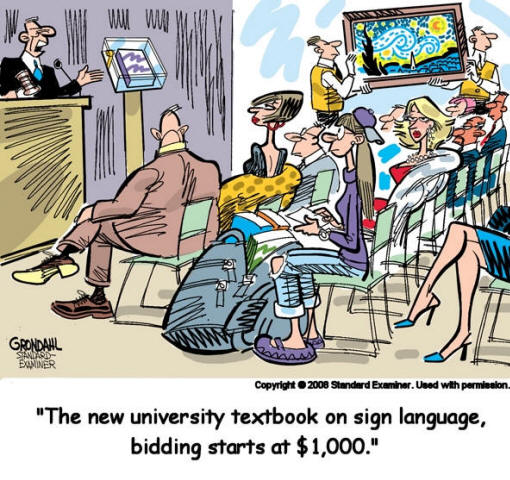
p.p.s. This cartoon (adapted with permission from the artist) sums up my philosophy regarding curriculum. Students shouldn't have to pay outrageous amounts of money just to learn sign language.
-Dr. Bill
Hello ASL Heroes!
I'm glad you are here! You can learn ASL! You've picked a great topic to be studying. Signing is a useful skill that can open up for you a new world of relationships and understanding. I've been teaching American Sign Language for over 20 years and I am passionate about it. I'm Deaf/hh, my wife is d/Deaf, I hold a doctorate in Deaf Education / Deaf Studies. My day job is being a full-time tenured ASL Instructor at California State University (Sacramento).
What you are learning here is important. Knowing sign language will enable you to meet and interact with a whole new group of people. It will also allow you to communicate with your baby many months earlier than the typical non-signing parent! Learning to sign even improves your brain! (Acquiring a second language is linked to neurological development and helps keep your mind alert and strong as you age.)
It is my goal to deliver a convenient, enjoyable, learning experience that goes beyond the basics and empowers you via a scientifically engineered approach and modern methodologies that save you time & effort while providing maximum results.
I designed this communication-focused curriculum for my own in-person college ASL classes and put it online to make it easy for my students to access. I decided to open the material up to the world for free since there are many parents of Deaf children who NEED to learn how to sign but may live too far from a traditional classroom. Now people have the opportunity to study from almost anywhere via mobile learning, but I started this approach many years ago -- way before it became the new normal.
You can self-study for free (or take it as an actual course for $483. Many college students use this site as an easy way to support what they are learning in their local ASL classes. ASL is a visual gestural language. That means it is a language that is expressed through the hands and face and is perceived through the eyes. It isn't just waving your hands in the air. If you furrow your eyebrows, tilt your head, glance in a certain direction, lean your body a certain way, puff your cheek, or any number of other "inflections" --you are adding or changing meaning in ASL. A "visual gestural" language carries just as much information as any spoken language.
There is much more to learning American Sign Language than just memorizing signs. ASL has its own grammar, culture, history, terminology and other unique characteristics. It takes time and effort to become a "skilled signer." But you have to start somewhere if you are going to get anywhere--so dive in and enjoy.
Cordially.
- Dr. Bill